

Applied Blockchain Contributes to MIT & SODA Labs Research on Digital Asset Interoperability
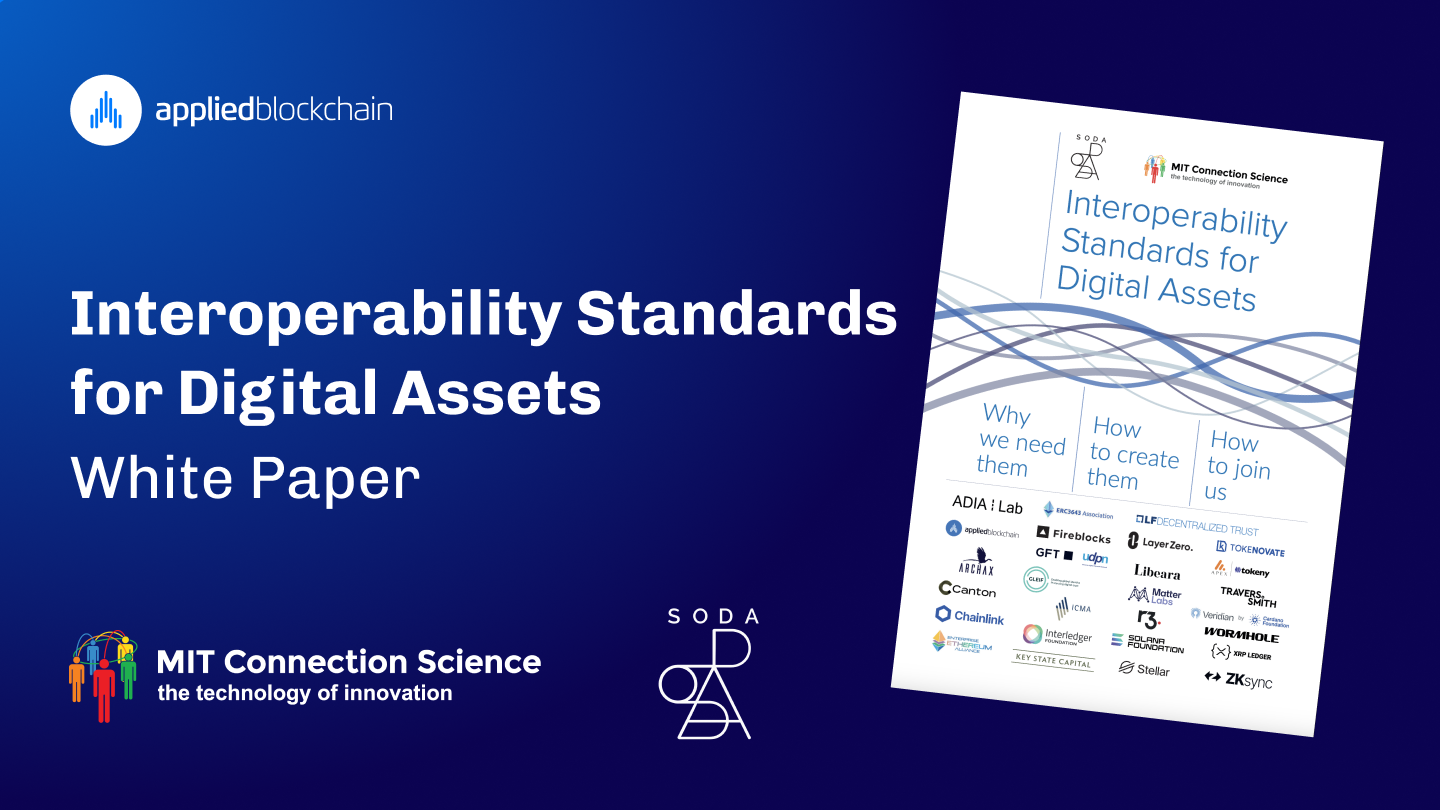
Applied Blockchain recently contributed to a white paper led by MIT Connection Science & SODA Labs exploring interoperability standards for digital assets. The paper examines the technical and structural foundations required to enable institutional-scale tokenization across networks while meeting regulatory and confidentiality requirements.
This article is Applied Blockchain’s contributed section from that research. It reflects an applied, real-world perspective informed by over a decade of building production blockchain systems across regulated finance, supply chains, and global enterprises.
You can read the full white paper on the SODA Labs website.
Taking tokenization to the next stage
“We’re at the beginning of the tokenization of all assets.” — Larry Fink, BlackRock CEO
The opportunity is substantial. Analysts project that tokenized real-world assets could exceed $16 trillion in value by 2030, as payments, securities, and financial instruments move on-chain. If every asset class were ultimately tokenized, as Fink suggests, the total value of global financial assets could approach $867 trillion (World Economic Forum).
Market foundations are in place: mature Layer 1 networks, established token standards, growing regulatory clarity, and an increasing understanding of tokenization's efficiency gains. Yet institutional adoption remains limited by a persistent gap: the absence of infrastructure that maximizes interoperability without compromising confidentiality.
To move from largely internal deployments to an open network that delivers blockchain efficiencies at scale, institutions must be able to verify ownership, eligibility, and compliance without exposing commercially sensitive data. Achieving this balance, programmable privacy within interoperable systems, defines the next stage of tokenization.
About Applied Blockchain
Applied Blockchain has spent over a decade designing and delivering blockchain systems across finance, energy, and supply chains. Our work with leading institutions, including Shell, Bank of America, Barclays, and the United Nations, has consistently revealed that the barriers to scaling tokenization are not purely technical, they are also structural. Interoperability, trust, and privacy determine whether institutions can collaborate and transact securely across networks.
For regulated markets to adopt blockchain at scale, these elements must converge: shared standards for interoperability, and privacy mechanisms that protect commercial and compliance-sensitive data. This intersection defines Applied Blockchain’s focus and ongoing technical innovation.
The Interoperability-Privacy Challenge
Ethereum has become the de facto standard for digital asset tokenization. Its token frameworks (ERC-20, ERC-3643) and development stack (EVM, Solidity) function as the HTTP, HTML, and JavaScript of blockchain infrastructure. Yet institutional adoption continues to stall at a familiar fault line: the trade-off between public transparency and private control.
Private and permissioned networks ensure compliance and confidentiality but isolate liquidity and restrict efficiency gains. Public networks enable composability and maximize efficiency gains but expose sensitive financial activity and participant identities. True interoperability in regulated finance requires more than connecting ledgers; it requires connecting trust.
Regulation requires transparency and auditability, yet institutions must also protect commercially and legally sensitive information. Without privacy, interoperability breaks down precisely where regulation begins. This is not a technical limitation of blockchain; it is a design gap in how current standards and infrastructure handle confidential information.
This next generation of infrastructure must support both: true blockchain efficiency and commercial privacy.
Evolving Standards: Confidential Token Frameworks
ERC-20 is the most widely adopted token standard, with ERC-3643 gaining traction for regulated digital asset issuance. Both enable composability across EVM-compatible networks, forming the foundation of tokenized finance. Yet they were designed for transparency, not confidentiality: every balance, wallet address, and transaction detail is visible on-chain. This transparency supports auditability and verification but limits institutional and commercial use.
The next evolution is not a new standard but an extension; frameworks that preserve ERC compatibility and composability while embedding programmable privacy. This approach allows confidentiality to coexist with composability, preserving existing infrastructure while unlocking new use cases.
The next evolution is not a new standard but an extension; frameworks that preserve ERC compatibility and composability while embedding programmable privacy. This approach allows confidentiality to coexist with composability, preserving existing infrastructure while unlocking new use cases.
Applied Blockchain's Unopinionated Confidential ERC Framework (UCEF) exemplifies this model. Built with standard Solidity constructs, UCEF introduces privacy at the data level, allowing issuers and participants to control who can view balances, counterparties, or transaction metadata without altering the ERC-20 interface. As a result, UCEF remains fully composable with existing decentralized applications, wallets, and infrastructure.
Unlike other confidential token models that mandate a single cryptographic method, UCEF is cryptography-agnostic. Developers can integrate TEEs, ZKPs, or other privacy mechanisms depending on regulatory, performance, or security needs. This flexibility is critical in a multi-jurisdictional environment where compliance obligations vary and technology continues to evolve.
The same principles apply to UCEF-3643, Applied Blockchain’s confidential implementation of the ERC-3643 standard used for compliant security tokens. UCEF-3643 combines identity-based permissions and regulatory controls with transaction-level privacy, concealing ownership and trade data from public view. In doing so, it demonstrates that compliance and confidentiality can reinforce, not oppose, one another.
These frameworks demonstrate that privacy and interoperability are not opposing forces. By maintaining compatibility with existing token standards, confidential frameworks allow institutions to adopt privacy-preserving capabilities without fragmenting liquidity or abandoning established infrastructure.
Evolving Infrastructure: Privacy-Enabled Layer 2s
Standards alone are insufficient. Scaling tokenization also requires infrastructure that supports privacy-preserving computation and verification at institutional throughput.
Layer 2 networks extend the capabilities of established Layer 1s, such as Ethereum, while offering flexibility in design and governance. Among them, privacy-enabled Layer 2s represent a critical evolution: infrastructure that enables secure computation and verification without exposing sensitive data.
Applied Blockchain’s Silent Data illustrates this approach. It operates as a privacy-preserving Layer 2 built on the OP Stack, directly integrated with Ethereum. Rather than creating an isolated network, Silent Data extends the Ethereum ecosystem, inheriting its security, decentralization, and composability while adding a programmable privacy layer.
Silent Data uses Trusted Execution Environments (TEEs) and cryptographic attestations to enable sensitive data to be processed. Standard Solidity smart contracts can verify facts such as ownership, eligibility, or compliance status without revealing the underlying information. This approach supports compliance where regulation, privacy, and interoperability align.
TEEs offer distinct advantages in this context. Unlike zero-knowledge proofs (ZKPs), which can impose significant computational overhead and complexity, TEEs provide high performance and straightforward auditability. For regulated institutions, this matters: compliance teams and regulators can verify that computations occurred correctly within a secure environment without requiring specialized cryptographic expertise.
Silent Data also supports selective disclosure: participants can choose what information to reveal and to whom. An issuer might prove to a regulator that all token holders meet accreditation requirements without disclosing individual identities. A corporation might demonstrate compliance with transaction limits without revealing counterparty relationships or deal terms. This granularity is essential in environments where transparency to regulators must coexist with confidentiality in commercial relationships.
A Layer 1 network such as Ethereum provides a recovery mechanism for asset holders if a Layer 2 were to fail or become corrupted. This feature enables further compliance by reducing the onus of decentralized security on the Layer 2, enabling the Layer 2 network to be comprized of permissioned node validators.
As a privacy layer built on Ethereum, Silent Data complements the modular ecosystem of Layer 2s and rollups, extending their interoperability with privacy-preserving capabilities. It demonstrates how tokenization infrastructure can operate across networks while maintaining compliance, performance, and confidentiality.
Looking Ahead: Privacy as Standard, Not Feature
The internet scaled through open protocols that made connectivity a given rather than a challenge. Blockchain will scale through privacy-preserving interoperability standards that make trust verifiable across networks by default.
Privacy should not be treated as an optional add-on or a niche feature for specific use cases. It must become an intrinsic design principle, embedded in token standards, infrastructure, and governance frameworks. When privacy is a standard, interoperability follows naturally: institutions can connect, verify, and transact without the binary choice between openness and control.
Applied Blockchain's work on confidential token frameworks (UCEF, UCEF-3643) and privacy-enabled infrastructure (Silent Data) demonstrates how existing systems can evolve to meet institutional requirements without requiring wholesale replacement. The foundations – Ethereum, ERC standards, Layer 2 modularity – are sound. What remains is to extend them with privacy-preserving capabilities that operate at scale.
The next generation of tokenization will be defined by consolidation rather than dispersion of chains, connecting more securely, privately, and at scale.
That convergence – where standards, infrastructure, and privacy align – is already taking shape. The industry's task is to accelerate it, ensuring that technical foundations match the scale of the opportunity ahead.
This article is adapted from Applied Blockchain’s contribution to the MIT Connection Science & SODA Labs white paper on interoperability standards for digital assets.
Read the full white paper on the SODA Labs website.